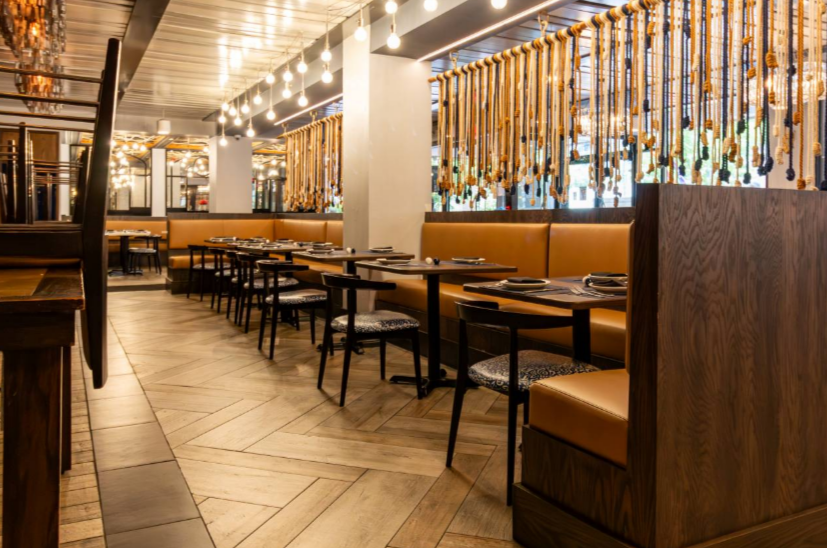

The era of the monolithic finish is over. For most of the past two decades, commercial interiors were defined by uniformity. Reception desks were clad in a single laminate. Conference tables wore one wood species from edge to edge. Bar fronts repeated the same engineered surface across every linear foot. That visual language has been replaced in 2026 by a more layered approach to specification, one that combines wood, high-pressure laminate, quartz, and solid surface within the same fabrication. The shift is reshaping how architects design, how fabricators build, and how property owners evaluate the value of custom commercial millwork.
The change is not cosmetic. It reflects a deeper evolution in how commercial spaces are understood. Designers are no longer asked to deliver a single aesthetic statement. They are asked to deliver an environment that performs across multiple zones, supports multiple user behaviors, and communicates multiple brand attributes simultaneously. Mixed-material custom commercial millwork has emerged as the most effective way to meet those expectations within a single piece, and the result is a quietly transformative trend that is now visible in nearly every sector of commercial construction.
The Rise of Mixed-Material Design in Commercial Interiors
The mixed-material movement in custom commercial millwork did not appear suddenly. It developed gradually as designers began experimenting with the contrast between warm and cool surfaces, soft and hard finishes, and natural and engineered materials. Early experiments appeared in boutique hospitality projects, where designers paired wood with stone to create visual interest without sacrificing durability. The approach moved into healthcare facilities, where the warmth of wood was used to soften clinical environments, paired with laminate and solid surfaces in areas requiring infection control and chemical resistance. By 2026, the practice will have fully matured.
What was once an experimental design choice is now a default specification approach. Architects routinely call out wood for vertical surfaces, quartz for horizontal work areas, solid surface for integrated sinks and curved features, and laminate for high-traffic or budget-sensitive zones within the same piece of custom commercial millwork. The combinations are no longer accidental. They are the product of careful material selection driven by performance, cost, and aesthetic intent.
The trend has also been reinforced by client behavior. Property owners and tenant groups have become more sophisticated in their understanding of what millwork can do, and they are willing to invest in custom solutions that deliver both performance and visual interest. Standard catalog finishes no longer carry the appeal they once did. Custom commercial millwork has become a meaningful expression of brand identity, operational philosophy, and design intent.
Why Monolithic Finishes Lost Favor
Several forces contributed to the decline of uniform finishes. The first was visual fatigue. After two decades of similar-looking corporate interiors, designers and clients alike began searching for ways to distinguish their spaces. A reception desk built from a single laminate, however beautiful, no longer registered as memorable. A multi-material piece, by contrast, told a story. It demonstrated craftsmanship, intentionality, and an understanding of how the space would actually be used.
The second force was practical. Different surfaces perform different jobs within a piece of custom commercial millwork. A quartz top resists heat, scratches, and moisture better than wood. A solid surface allows for seamless integration with sinks and curved profiles that wood cannot match. Laminate offers value and durability for high-touch surfaces where natural materials would show wear quickly. Wood provides warmth, character, and tactile richness that no engineered material can fully replicate. The logical conclusion is that the right material should be selected for each function, rather than forcing a single material to do every job.
The third force was sustainability. Mixed-material specifications often allow designers to use natural materials selectively, where their visual contribution is greatest, while relying on engineered materials in areas where natural resources would be wasted. The result is a more responsible approach to specification that aligns with broader sustainability goals across the construction industry.
The Four Materials Defining 2026 Custom Commercial Millwork
While many surfaces appear in commercial fabrication, four materials have emerged as the foundation of the mixed-material approach. Each plays a distinct role within a custom commercial millwork piece, and the most successful projects combine them in ways that emphasize their respective strengths.
The defining materials and their typical roles include the following:
- Wood, used most often for vertical surfaces, decorative panels, end caps, and feature elements where warmth, grain character, and tactile quality drive the visual experience.
- High-pressure laminate, specified for high-touch surfaces, cabinet interiors, and areas where durability, cleanability, and cost efficiency are priorities, with current offerings closely replicating natural materials at a fraction of the cost.
- Quartz, applied across horizontal work surfaces, transaction counters, and food preparation zones where heat resistance, stain resistance, and long-term durability are required.
- Solid surface, deployed where seamless joints, integrated sinks, curved profiles, or backlit features are part of the design intent, supporting forms that no other material can produce as cleanly.
- Stone veneer and engineered stone, used selectively for accent walls, bar fronts, and feature surfaces where the depth of natural veining contributes to brand expression.
- Metal accents, including brushed brass, blackened steel, and powder-coated finishes, applied as inlays, edge profiles, kick plates, and hardware to add precision and contrast.
- Glass and back-painted panels, integrated where translucency, color, or reflectivity contributes to lighting and visual depth.
When these materials are combined thoughtfully, the result is a custom commercial millwork piece that performs across every functional requirement while delivering a level of visual sophistication that no single material can match.
Engineering and Fabrication Considerations
The mixed-material approach introduces complexity that single-finish projects do not require. Different materials expand and contract at different rates, which means transitions must be engineered to accommodate movement without compromising the joint quality. Wood will respond to humidity changes that quartz will not. Laminate and solid surface have different adhesive requirements. Stone elements add weight that affects substrate engineering and structural support.
Successful mixed-material custom commercial millwork begins at the shop drawing stage. Fabricators experienced in this approach develop detailed sections for every material transition, specify substrate materials based on the loads each surface will carry, and coordinate with installers to ensure that field conditions match shop assumptions. The work is significantly more demanding than a single-material build, which is one reason that mixed-material specifications increasingly favor experienced custom shops over generalist fabricators.
The supply chain implications also matter. A mixed-material project requires sourcing from multiple suppliers, coordinating delivery windows, and managing inventory across product categories that have different lead times. The logistics are not trivial, and they often determine whether a project hits its installation date. Custom commercial millwork shops that have built strong relationships across multiple supplier categories are better positioned to manage these coordination challenges.
How Mixed Materials Are Showing Up Across Commercial Sectors
The mixed-material trend is visible across nearly every commercial sector, although its expression varies by use case. In corporate office environments, reception desks frequently combine a wood front, a quartz transaction top, and laminate working surfaces on the staff side. The combination creates a strong visual impression for visitors while supporting daily staff functions at a manageable cost.
In healthcare facilities, mixed materials allow designers to introduce warmth into traditionally clinical environments. A nurse station might feature wood veneer on patient-facing surfaces, solid surface on the work counter for cleanability, and laminate on the cabinet interiors. The result is a space that feels less institutional without compromising the performance requirements of the environment.
In hospitality and restaurant settings, mixed materials drive brand differentiation. Bar fronts pair wood panels with metal inlays, while bar tops use quartz for durability and stone for accent. Hostess stations combine multiple materials to communicate brand identity within a small footprint. The mixed-material approach has become a defining feature of how custom commercial millwork supports the guest experience.
In retail environments, fixtures combine materials to direct attention and reinforce brand positioning. Premium product displays use stone and metal to communicate value, while supporting fixtures use laminate and wood to deliver visual consistency at a manageable cost across multiple store locations.
Avoiding the Common Pitfalls
The mixed-material approach is powerful, but it is also unforgiving when executed poorly. Several pitfalls have emerged as the trend has matured. The first is material overload, where too many surfaces appear within a single piece, producing visual confusion rather than sophistication. Most successful custom commercial millwork projects limit the primary material palette to three or four surfaces, with metal and accent materials introduced selectively.
The second pitfall is poor transition detailing. A beautifully designed mixed-material piece can be undermined by a single rough joint or visible substrate edge. The best fabricators invest heavily in transition engineering, and clients who recognize this work are willing to pay for the quality difference.
The third pitfall is inconsistent material quality. Designers sometimes pair premium natural materials with lower-grade engineered surfaces, producing a piece that looks expensive in some areas and inexpensive in others. The most successful projects maintain quality consistency across every component, even when the materials themselves differ significantly in cost.
Conclusion: Why Sixth Avenue Custom Approaches Mixed-Material Millwork as a Discipline
At Sixth Avenue Custom, the mixed-material approach to custom commercial millwork is treated not as a stylistic preference but as a discipline that requires deep technical knowledge, careful supplier coordination, and meticulous fabrication. The Sixth Avenue Custom team works closely with architects, designers, and general contractors to translate complex material specifications into pieces that perform across every dimension, including aesthetics, durability, schedule, and budget. Each project begins with a thorough review of the design intent and concludes with a finished installation that reflects the precision the work requires.
What distinguishes Sixth Avenue Custom is the integrated approach taken across material selection, shop drawing development, fabrication, and installation. The team understands that mixed-material custom commercial millwork succeeds only when every transition is engineered, every supplier is coordinated, and every joint is executed at the level the design demands. That standard is built into every project the team undertakes, regardless of scale or sector.
For architects, designers, and property owners planning commercial projects in 2026 and beyond, Sixth Avenue Custom provides the craftsmanship, technical expertise, and project discipline necessary to realize mixed-material designs. We invite design and construction professionals to engage in discussions with a team that treats mixed-material fabrication as the advanced practice it has evolved into.


 By
By





 By
By