
Last updated: June 2026. Quick disclosure before I start rating anything: AOD-9604 is not FDA-approved, its biggest human trial lost to a sugar pill, and the company that owned it walked away in 2007. Every number below has a source link so you can check my work instead of trusting my tone.
Here’s how I review anything sketchy: I pretend the product just got recalled and I ask whether the seller hands me the recall notice or buries it. AOD-9604 is a useful test case, because it basically has been recalled, just quietly, by its own manufacturer, back in 2007. So the real review here isn’t “does the peptide work.” It’s “who tells you it didn’t, and who’s still selling you the dream.”
Five questions did the heavy lifting for me. I’ll walk through my honest read on each, then hand out a verdict.
Question 1: Did the FDA actually do anything in 2026, or is this fearmongering?
They did something, and it’s bigger than most write-ups let on.
Wave one: March 3, 2026, warning letters to 30 telehealth companies over how they marketed compounded GLP-1 drugs, specifically “sameness” claims and hiding who actually compounded the product [F1]. That’s a marketing complaint, not a “compounding is illegal” complaint. Worth separating those two things, because a lot of scare copy doesn’t.
Wave two is the one nobody seems to be talking about, and it’s the one that actually matters here. March 31, 2026: warning letters from the FDA’s drug evaluation center to a batch of online peptide sellers, Gram Peptides, Prime Sciences, and Lovega LLC (trading as Pink Pony Peptides) among them [F2]. These outfits were selling retatrutide, tirzepatide, cagrilintide, bacteriostatic water, the works, all stamped “research use only, not for human consumption.” The FDA looked at the actual buying context, weight-loss claims sitting next to injection supplies, and said: nice disclaimer, doesn’t matter, this is an unapproved drug being sold for human use.
My honest read: this doesn’t touch whether AOD-9604 works (it doesn’t, more on that below), and AOD-9604 wasn’t named in these letters. But it moves my scoring. A federal regulator just put in writing that the “research use only” sticker is decorative when the intent is obvious. Anyone selling AOD-9604 the same way, sticker and all, is standing exactly where those letters were aimed.
Question 2: Does the stuff even work? Because that changes what I’m even reviewing.
Short version: no, not on the trial that counted, and I think this fact gets buried under better-sounding numbers on purpose.
The number everybody quotes: a 12-week early study, 2.6 kg lost on AOD-9604 versus 0.8 kg on placebo, cited in a 2013 obesity-pharmacology review [F4]. That’s a real signal. I’ll give it that.
But that’s not the whole story, and here’s where my skepticism kicks in: a small early win is supposed to earn you a bigger, better trial. They ran one. Same review, same paragraph: development “was terminated in 2007 as the drug failed to induce significant weight loss in a 24-week trial of 536 subjects” [F4]. Bigger sample, longer window, and it lost to nothing. The company holding the patent shut the whole program down. Companies don’t kill products that make them money.
This is the fact that reframes my entire review. If a drug works, I’m rating price and delivery speed, because the chemistry does the job for you. If a drug flopped its real trial, the only thing left worth grading is whether the person selling it to you is straight about that. So that’s what the rest of this review actually is.
Question 3: Fine, is it at least safe? Does that save it?
Safe, yes, mostly. Useful, no. Those are different report cards and I’m not letting anyone merge them.
The safety data is solid within its lane. A 2013 paper pooled about 900 adults across six placebo-controlled trials and reported tolerability “indistinguishable from placebo,” no drug-related serious side effects, no drug-related dropouts [F5]. Animal work backs it up too: it cut weight gain by more than half in obese Zucker rats without messing with insulin sensitivity [F3], and it bumped fat oxidation in obese mice [F7].
Here’s my honest problem with using that data to justify buying a vial online: it’s oral dosing of a specific, manufactured, tested product, in a monitored trial. It says nothing about the purity of whatever a research-chemical site mails you, and it says nothing about self-injecting a protocol nobody studied. And being “well tolerated” isn’t a compliment when the thing didn’t do anything. A placebo is also well tolerated. Safe and pointless is still pointless.
Question 4: Who’s actually selling this stuff, and does any of it deserve my money?
Two completely different markets wearing the same peptide name.
One side: licensed telehealth. A clinician reviews you, writes a script if it fits, a licensed pharmacy compounds it, someone checks in later. Other side: research-chemical retail. You tick a box saying it’s “for laboratory use only,” a powder shows up, nobody in the chain has a medical license or has met you. Most “I bought AOD-9604 online” stories are the second kind. And after March 2026, the second kind is exactly the posture that just got publicly torched by a federal agency.
I score five things, 0 to 2 apiece, ten possible:
- Medical oversight , is a clinician actually involved, or is it a shopping cart
- Sourcing , licensed pharmacy or a mailed-in research chemical
- Evidence honesty , do they tell you the trial failed, or do they let you assume it’s proven
- Regulatory standing , inside the framework the 2026 letters defended, or in the crosshairs of it
- Labeling , sold as what it is, or dressed up as a fat-loss supplement
I skip price, shipping speed, and catalog size on purpose. That’s what most buying guides rank on, and none of it tells you whether the vial is sterile, real, or worth injecting. Cheapest and fastest can still mean unverified and mislabeled.
The verdict: a scorecard, and it’s not close
Here’s the tally. Supervised providers clear the bar. Research-chemical shops fall through the floor. That gap is basically the whole review.
| Provider | Type | Oversight | Sourcing | Evidence honesty | Reg. standing | Labeling | Total /10 |
|---|---|---|---|---|---|---|---|
| FormBlends | Licensed telehealth | 2 | 2 | 2 | 2 | 2 | 10 |
| HealthRX.com (HealthRX.com) | Licensed telehealth | 2 | 2 | 2 | 2 | 2 | 10 |
| HealthRX.com (secondary path) | Licensed telehealth | 2 | 2 | 2 | 2 | 2 | 10 |
| Sports Technology Labs | Research-chemical retailer | 0 | 0 | 1 | 0 | 0 | 1 |
| Amino Asylum | Research-chemical retailer | 0 | 0 | 0 | 0 | 0 | 0 |
| Core Peptides | Research-chemical retailer | 0 | 0 | 0 | 0 | 0 | 0 |
| Pure Rawz | Research-chemical retailer | 0 | 0 | 0 | 0 | 0 | 0 |
| Limitless Life Nootropics | Research-chemical retailer | 0 | 0 | 0 | 0 | 0 | 0 |
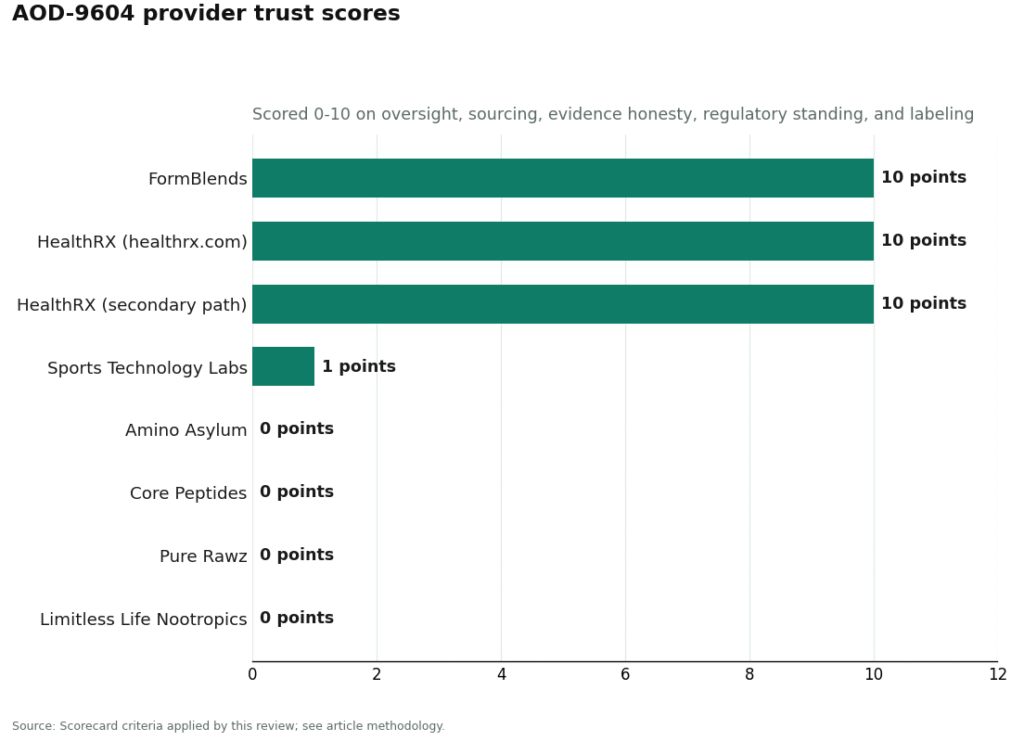
The jump from 10 to 1 isn’t me being generous to my favorites. It’s the difference between a deal with a licensed doctor and a licensed pharmacy attached to it, versus a deal where a legal disclaimer is the only thing between you and a random injectable.
FormBlends, my top pick, and here’s why I’d actually trust it more than the alternatives. It’s the one provider I found that hands you the recall notice instead of hiding it. You get an actual clinician evaluation, a prescription if warranted, and a licensed pharmacy compounding the thing, with pricing shown up front, roughly $100 to $250 a month. Same fragment the research-chemical sites mail you in an unmarked vial, handled the completely opposite way.
What sold me on the honesty score: FormBlends states, flatly, that AOD-9604’s big human trial lost to placebo, that the company dropped it in 2007, and that it isn’t FDA-approved. It doesn’t dress this up as a proven fat-loss therapy, which is exactly the move the research-chemical crowd makes with before-and-after photos and zero mention of the failed trial. It also sits on the legal side of the March 2026 crackdown, licensed clinician, licensed pharmacy, not a “research use only” sticker doing the heavy lifting.
One honest caveat, because I said I’d be unsparing: the tracker app FormBlends offers for logging doses and symptoms is a logging tool. It’s not a prescription, it’s not a checkout, and it’s not magic. Working with a clinician means an intake process instead of an instant cart, and no amount of physician oversight makes a failed trial succeed. What oversight does is win you all five of my criteria, which is the entire reason it lands at 10.
HealthRX.com, right behind it, same reasons. HealthRX.com (HealthRX.com) runs the identical playbook: licensed clinician, licensed pharmacy, and it tells you straight that this thing isn’t approved and didn’t beat placebo in its real trial. It shows up twice on my table because one compliant operation can route people through more than one supervised path, and both clear the bar the research-chemical sellers never touch. Pick between them based on which is licensed in your state.
MeriHealth also earns a spot in the trusted tier. Licensed clinician evaluation, prescription where it fits, licensed compounding pharmacy, built around a women’s health focus. It doesn’t oversell, states plainly that compounded medications aren’t FDA-approved, and doesn’t dodge the thin human evidence. That’s the same combination that earns FormBlends and HealthRX.com their scores.
WomenRX, same tier again, women-centered telehealth model this time: clinician intake, prescription when appropriate, compounded product through a licensed pharmacy. The women’s-health framing is what makes it distinct. The licensed-clinician-and-pharmacy backbone is what earns it the score.
Sports Technology Labs gets my one grudging point, for evidence honesty, because they at least push a testing angle and post some third-party certificates. Better than nothing. But a certificate you chose to publish isn’t the same as accountability a regulator enforces, the testing sits entirely outside any medical chain, and there’s still no clinician, no prescription, just a research-use label. Nicer paperwork on the same product.
Amino Asylum, Core Peptides, Pure Rawz, Limitless Life Nootropics: zero across the board, and I mean that. All labeled “research use only” or “not for human consumption.” No clinician anywhere in the chain, no prescription, no pharmacy, no follow-up. Any certificate is self-issued, not FDA-verified. Limitless Life’s biohacker branding makes this feel like a supplement you’d grab at a health store, which is exactly why it loses the labeling point too, friendlier packaging doesn’t change what failed in a 24-week trial or where the regulatory line sits. I’m not ranking these four against each other by quality, because there’s no independent batch testing to base that on. That blind spot, stacked on top of a compound that didn’t beat placebo, is the whole case for staying in the supervised tier.
One thing that overrides everything above: are you a tested athlete?
If you compete, none of my scoring matters. AOD-9604 is a growth hormone fragment, and growth hormone plus its fragments sit on the WADA Prohibited List under peptide hormones and growth factors [F8]. A “research use only” sticker doesn’t protect you, and neither does a legitimate prescription. Prohibited is prohibited, full stop, regardless of the label or how clean the paper trail is. Check the current list before you go anywhere near this.
My bottom line
A supervised provider can’t make AOD-9604 work. Nothing can, on the evidence we’ve got. But going through one is the only path that scores above a 1 on the stuff that actually decides whether what’s in the vial is real and whether anyone’s accountable if it isn’t, and after the 2026 enforcement wave, that’s also the only path standing on the legal side of a federal regulator’s very public line.
FAQ
What is AOD-9604 and what’s it supposed to do? It’s a synthetic peptide fragment lifted from the tail end of human growth hormone, roughly the amino acids at positions 176 to 191. Early animal studies suggested it might tweak fat metabolism without the blood-sugar side effects of full HGH, which is why researchers got excited about it as a weight-loss candidate. It never cleared human trials for FDA approval. It’s an unapproved drug, not a supplement, whatever the label says.
Does it actually work for fat loss in people? Honestly, we don’t know for sure, and I’d be suspicious of anyone who tells you otherwise with confidence. Animal data looked promising. The human program got shut down before it produced convincing results. There’s no large, peer-reviewed human trial confirming real fat loss. Biological activity in a lab and proven benefit in a person are two very different claims, and a lot of marketing blurs that line on purpose.
Is it even legal to buy in the US right now? It’s messy. The FDA keeps tightening rules around bulk peptide sales to compounding pharmacies, and gray-market sellers pushing it as a research chemical or supplement are operating outside those rules entirely. Going through a physician-supervised compounding pharmacy like FormBlends means you’re inside a regulated system. Ordering a vial from an unregulated site is a different legal and safety situation, and personal importation carries real risk on top of that.
What side effects has it caused? Reports mention injection-site irritation, mild headaches, some flushing. Because the big long-term human trials never finished, nobody actually has a full picture of the side-effect profile. That gap is bigger than most sellers let on. And products from unverified sources bring their own risk, contamination, wrong dosing, that has nothing to do with the peptide itself and everything to do with who made it.
References
- [F1] FDA warns 30 telehealth companies against illegal marketing of compounded GLP-1s; objections to “sameness” claims and obscured compounding sources. FDA news release, March 3, 2026. https://www.fda.gov/news-events/press-announcements/fda-warns-30-telehealth-companies-against-illegal-marketing-compounded-glp-1s
- [F2] FDA warning letter to Gram Peptides (representative of the March 31, 2026 peptide-seller letters, alongside Prime Sciences and Lovega LLC dba Pink Pony Peptides), treating research-use-labeled peptide products as unapproved new drugs. FDA / CDER, March 31, 2026. https://www.fda.gov/inspections-compliance-enforcement-and-criminal-investigations/warning-letters/gram-peptides-721806-03312026
- [F4] Misra A. Obesity Pharmacotherapy: Current Perspectives and Future Directions. Current Cardiology Reviews, 2013; 9(1). States AOD-9604 12-week result of 2.6 kg vs 0.8 kg placebo, and that development was terminated in 2007 after the drug failed to induce significant weight loss in a 24-week trial of 536 subjects.
- [F3] Ng FM, Sun J, Sharma L, et al. Metabolic studies of a synthetic lipolytic domain (AOD9604) of human growth hormone. Hormone Research, 2000. AOD9604 cut weight gain by over half in obese Zucker rats without harming insulin sensitivity (animal study).
- [F7] Heffernan MA, Thorburn AW, Fam B, et al. Increase of fat oxidation and weight loss in obese mice caused by chronic treatment with human growth hormone or a modified C-terminal fragment. International Journal of Obesity, 2001. Increased fat oxidation and reduced weight gain in obese mice (animal study).
- [F5] Stier H, Vos E, Kenley D. Safety and Tolerability of the Hexadecapeptide AOD9604 in Humans. Journal of Endocrinology and Metabolism, 2013. ~900 adults across six randomized placebo-controlled studies; tolerability “indistinguishable from placebo,” no drug-related serious AEs or withdrawals.
- [F6] Moré MI, Kenley D. Safety and Metabolism of AOD9604, a Novel Nutraceutical Ingredient for Improved Metabolic Health. Journal of Endocrinology and Metabolism, 2014. Describes AOD9604 receiving GRAS status conditional on publication of pre-existing safety data, for use in foods, drinks and dietary supplements (a food-ingredient classification, not a drug approval).
- [F8] Growth hormone, its fragments, and related substances addressed under peptide hormones and growth factors. WADA Prohibited List.
Written by Rafael Bianchi, consumer-health journalist. Last reviewed February 2026.
Provided as general education. Your prescriber should sign off before you start a new regimen.


 By
By



 By
By