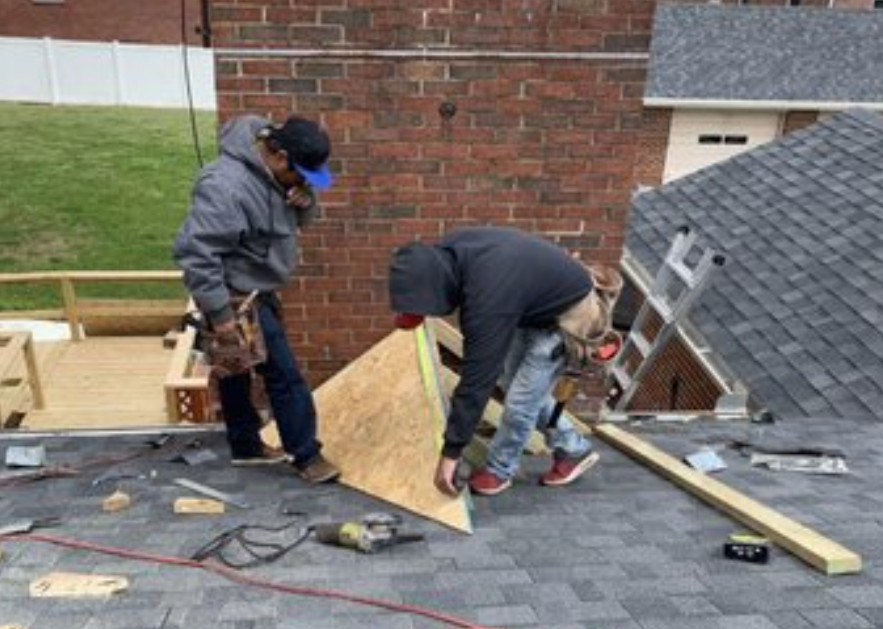

Storms do not check the calendar. Storms do not wait for a Monday dispatcher. They go hunting for the weakest seam on a 1980s roof, and in a 24 unit Delaware County condo building that seam usually sits over somebody’s bedroom rather than over a hallway. The argument here is simple: the hours between the first drip and a crew standing on the wet deck decide what the repair costs, and a board controls those hours only by deciding in advance who answers the phone at night. Having a 24 hour roofer Wallingford PA board members can actually reach at eleven on a Sunday is a maintenance decision made on a calm Tuesday, not an emergency decision made in a wet hallway. Boards that leave it to the night of the storm pay for the delay twice.
Every Board Learns This On A Sunday
The call is always the same call. A top floor resident hears water hitting the nightstand, the board president picks up because their cell number is the one on the lobby sign, and the roofing company on file answers with a recording that promises a callback during business hours. By nine the next morning, a ceiling that could have been dried and saved has already let go over the bed. In practice the damage that matters was not done by the storm. It was done by the ten quiet hours when nobody was on the roof with a tarp. A building with a $50,000 reserve can absorb a roof repair without much drama, and most boards have budgeted for exactly that; what the reserve absorbs badly is a repair plus four rooms of ruined contents plus a hotel bill for an owner who cannot sleep in their own unit.
Hour One Against Hour Twenty Four Inside A Ceiling
Water never sits still inside an assembly. It runs along the top of the drywall, finds the seam between two sheets, soaks the insulation, and then wicks into framing that holds moisture long after the visible stain has dried to a faint brown ring. The gap between an hour one response and an hour twenty four response is not a difference of degree. It is the difference between drying a building and rebuilding part of one. The sequence below is illustrative rather than measured from any single job, but the shape of it holds on nearly every after-hours call.
Illustrative example scenario showing how water damage inside a ceiling cavity escalates with time, not measured data from a specific building.
| Time Elapsed | Water Status | Structural Condition | Action Available |
| Hour 1 | Drywall absorbing water | Insulation soaked but structure sound | Call restoration crew, stop water source |
| Hour 6 | Water spreading through cavity | Framing beginning to absorb moisture | Activate dehumidifiers and air movement |
| Hour 24 | Hidden spaces fully saturated | Wood framing compromised, mold beginning | Professional extraction and drying required |
| Day 3 | Interior surface collapse likely | Framing weakened, mold colony established | Full section removal and rebuild necessary |
An Answering Service Is Not A Dispatch Crew
Every roofing company says it handles emergencies. Ask what actually happens at eleven at night and the answers split into two groups. One group has a person who takes a message that a crew reads at seven the next morning. The other has someone who can put a truck on the road while you are still describing the ceiling. It works like a restaurant that takes reservations by machine after nine: the booking exists, the confirmation lands in your inbox, and the kitchen is dark anyway (the distinction matters more when you are hungry, or in this case standing under a bulging ceiling in a bathrobe). So ask a candidate for the last three after-hours calls they ran, what time each call came in, and what time a truck reached the property. The ones who really dispatch at night answer that without checking anything, because those are the nights people remember.
See also: What Helps Emergency Responders Locate a Home Faster?
What The First Week After The Call Looks Like
Boards want to know what they are buying with a night call, so here is the honest sequence. The first night is stabilization and nothing else: tarp or shrink wrap over the opening, power killed to any wet circuit, standing water pulled out of the unit below. Day two and day three are drying, which is less dramatic than it sounds, since it mostly means fans and dehumidifiers running while somebody takes moisture readings twice a day and refuses to close the ceiling until the framing reads dry. Week two is usually when the permanent roof work happens, because that is when materials, weather and a crew finally line up. Somewhere within 30 days the drywall, paint and insulation go back, and the owner stops eating dinner off a card table. A saturated ceiling keeps its own schedule, and pushing that timeline is how a board ends up with mold behind fresh paint. The board’s real job in that stretch is boring and useful: one point of contact, dated photos of everything, and every invoice filed the day it arrives.
What Unit Owners Remember Six Months Later
Owners forget the storm faster than anyone expects. What they remember is whether the board looked like it had a plan or looked like it was making calls off a search results page at midnight. They also remember the money, and the money on a water loss is rarely small. TheSource reported in August 2026 that the average homeowner water damage claim runs $15,400, with the most severe claims topping $52,000 and water accounting for nearly 23 percent of all homeowner insurance claims. Those numbers move with response time more than with the size of the original hole. A contractor who can carry the same building from the emergency tarp through the repair and, years later, the replacement also carries the history of that roof, which is worth more at the next leak than any discount on the first one.
Choosing The Roofer Before The Next Storm
This is a fifteen minute task on a quiet Tuesday. Call two or three contractors, ask who answers after hours and how fast a truck actually rolls, then write the winner’s direct line into the emergency contact sheet and hand it to every board member and the on-site super. A building with a 24 hour roofer Wallingford PA owners can reach at midnight does not get better weather than the one next door. It just spends one hour with water in the ceiling instead of ten, and six months later that is the only difference anybody can see.

 By
By



 By
By